Selecting tapered roller bearings is not a catalog exercise. It is a reliability decision made under load, heat, speed, contamination, and space limits. A bearing may look correct on paper and still fail early in a dusty gearbox. Real installations are messier.
Industry guidance supports a disciplined approach. ISO 281 explains rating life calculations for rolling bearings, while ISO 15243 classifies common damage modes, including wear, brinelling, and fatigue. The Timken Engineering Manual also emphasizes load direction, preload, lubrication, and mounting accuracy. These references provide a sound technical base, but they cannot replace field measurements. Shaft deflection, housing distortion, and poor sealing often change the result.
The global bearing market remains significant, according to published analyses from Fortune Business Insights and Grand View Research. However, market growth does not make every product suitable. The right Bearing Roller Tapered selection depends on actual operating conditions, not advertising language. This guide introduces seven practical tips for comparing load capacity, internal clearance, material quality, lubrication, sealing, installation, and supplier support. Each tip connects engineering data with workshop reality. Check the numbers twice. A small error in preload can create heat, noise, and premature damage. One overlooked detail can matter most. The recommendations are useful, but they are not absolute; unusual speeds, shock loads, or contaminated environments may require manufacturer validation and application-specific calculations.
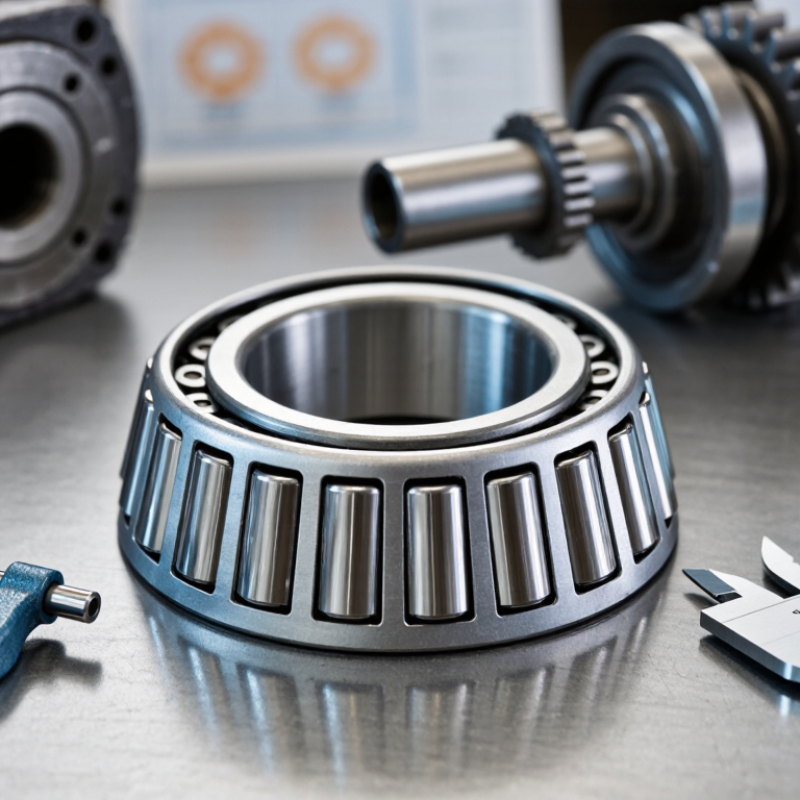
7 Tips for Choosing Tapered Roller Bearings
Define Duty Conditions Around ISO 281’s 90% L10 Rating-Life Basis
A bearing choice starts with duty conditions, not catalog capacity. Record radial load, axial load, speed, temperature, contamination, lubrication, and shock. Include mounting errors and operating hours. These details often change the answer.
ISO 281:2007 defines basic rating life, L10, as the life reached by 90% of identical bearings under stated conditions. Ten percent may fatigue earlier. The standard expresses L10 in one million revolutions or operating hours. This is a statistical reference, not a warranty. ISO 281 also uses dynamic load rating and equivalent dynamic bearing load. A high C value does not guarantee protection.
Seven checks deserve attention: match load direction, calculate combined loading, verify speed limits, check static safety, control fits, specify lubricant, and prevent contamination. For variable duty, use a load spectrum instead of one average load. Short shock events can dominate fatigue damage. ISO 281’s modified-life approach considers lubrication and contamination, but field data remains imperfect.
In workshop inspections, grease discoloration, brinelling, and uneven raceway marks often expose weak assumptions. A clean calculation can still fail after poor alignment. Review shaft stiffness, housing accuracy, preload, and thermal growth. Use ISO 16281 when internal load distribution or misalignment needs closer analysis. Recheck the estimate after installation data arrives. Real duty is rarely tidy.
Use this duty-condition checklist before selecting a tapered roller bearing. ISO 281 basic rating life is a statistical reference for 90% reliability under defined load, speed, lubrication, contamination, and operating conditions.
| Tip | Duty Dimension | Data to Define | ISO 281 / Selection Relevance | Practical Check |
|---|---|---|---|---|
| 1 | Load spectrum | Record radial load, axial load, load direction, shock level, and the percentage of operating time at each load condition. Use newtons (N) or kilonewtons (kN). |
Tapered roller bearings support combined radial and axial loads. For a constant equivalent dynamic bearing load P:
L10 = (C / P)10/3 million revolutions
where C is the basic dynamic load rating.
|
Build a duty histogram instead of using only the maximum load. For variable loading, calculate life for each load interval and combine the intervals using a damage or reciprocal-life method. |
| 2 | Speed and cycle profile | Define rotational speed in revolutions per minute (r/min), start-stop frequency, acceleration, reversing cycles, and operating time at each speed. |
ISO 281 life is expressed in millions of revolutions. Convert it to operating hours with:
L10h = (106 / (60n)) × L10
where n is speed in r/min.
|
Check the highest continuous speed and the transient speed separately. Confirm that heat generation, lubrication, cage behavior, and bearing limiting speed are acceptable at the actual duty cycle. |
| 3 | Target reliability and life | State the required life in operating hours, revolutions, or duty cycles, and identify whether the requirement is an L10 target or a higher reliability target. | L10 is the life at which 90% of an identical bearing population is expected to survive under the defined conditions. It is not a guarantee that every bearing will reach that life. | Do not compare an L10 target directly with a required average life or an individual guaranteed life. If higher reliability is required, use the applicable ISO 281 reliability modification factor and document the assumptions. |
| 4 | Lubrication condition | Define lubricant type, base oil viscosity, operating temperature, replenishment interval, lubricant quantity, and compatibility with seals or adjacent components. | The basic rating-life equation assumes an adequately lubricated rolling contact. Insufficient viscosity, starvation, grease degradation, or mixing incompatible lubricants can reduce practical service life even when calculated L10 is satisfactory. | Determine the lubricant’s operating viscosity at bearing temperature, not only its viscosity at the reference temperature. Verify relubrication access and interval under the actual speed, load, and contamination level. |
| 5 | Temperature and thermal limits | Measure or estimate inner-ring, outer-ring, housing, and lubricant temperatures. Include ambient temperature, heat sources, cooling, and thermal expansion. | Temperature affects lubricant viscosity, dimensional stability, clearance, seal performance, and material hardness. A life calculation based only on room-temperature assumptions may not represent the real duty. | Confirm the selected internal clearance, lubricant, seals, cage material, and heat-treatment capability for the complete temperature range, including start-up and abnormal conditions. |
| 6 | Contamination and sealing | Define dust, water, metal particles, process media, wash-down exposure, ingress paths, and the required sealing or shielding arrangement. | ISO 281 basic rating life does not by itself describe every form of contamination-related damage. Abrasive particles, water, and corrosive media can cause indentation, wear, corrosion, and premature fatigue. | Select sealing, filtration, housing protection, and lubricant cleanliness controls together. Inspect the shaft and housing interfaces because poor fits can create leakage paths or allow relative movement. |
| 7 | Fit, clearance, alignment, and mounting | Define shaft and housing tolerances, inner-ring and outer-ring mounting conditions, misalignment, preload or endplay, stiffness, shoulder dimensions, and installation method. | Incorrect fits or adjustment can create excessive preload, insufficient internal clearance, ring creep, edge loading, or roller skew. These effects can invalidate a load-only life estimate. | Check fit selection against ring load direction and thermal expansion. For paired tapered roller bearings, establish the specified setting method and verify endplay or preload after mounting. |
Record radial load, axial load, speed, temperature, contamination, lubrication, and shock. Include operating hours, mounting errors, shaft stiffness, and housing accuracy. Measure real conditions when possible.
L10 is the life reached by 90% of identical bearings under stated conditions. Ten percent may fatigue earlier. It is statistical, not a warranty.
A high dynamic load rating does not guarantee long service. Alignment, lubrication, contamination, heat, and shock can change the result. Duty conditions decide more than one catalog value.
Radial load acts inward, while axial load follows the shaft. Their ratio helps determine the suitable contact angle. Calculate the combined load rather than judging shaft diameter alone.
A larger angle usually carries more axial load and increases axial stiffness. It may also raise friction, heat, and misalignment sensitivity. Check the load spectrum, not only the peak load.
Back-to-back pairs resist overturning moments and provide a wider effective span. Face-to-face pairs tolerate some housing misalignment. Tandem pairs share axial load in one direction.
Use measured values instead of relying on feel. Small adjustments can change operating temperature by several degrees. Recheck endplay, vibration, and temperature after a short run.
Grease discoloration, brinelling, and uneven raceway marks deserve attention. They may indicate overload, poor lubrication, shock, or alignment problems. A clean calculation can still fail.
Use a load spectrum instead of one average load. Short shock events can dominate fatigue damage. I may underestimate risk if brief impacts are ignored.
Record temperature, noise, vibration, and axial movement. Review the estimate when field data arrives. Real duty is rarely tidy.
Choosing the right Bearing Roller Tapered design begins with clearly defining the operating conditions, including speed, temperature, duty cycle, shock, and expected service life. Use the ISO 281 L10 rating-life basis, which represents the life reached by at least 90% of a sufficiently large group of identical bearings under specified conditions. Calculate both radial and axial loads, then compare them with the dynamic ratings in ISO 281 and static ratings in ISO 76 to prevent fatigue or permanent deformation.
For combined loads, select an appropriate contact angle and pairing arrangement to achieve the required thrust capacity and stability. Control internal clearance and shaft or housing fits according to ISO 5753 and ISO 286, since excessive or insufficient interference can affect heat generation and alignment. Finally, confirm that the bearing’s speed capability, lubricant, and sealing arrangement suit the application, while keeping operating temperature within the 120°C class limit. These checks help ensure reliable performance, predictable maintenance intervals, and efficient long-term operation.

 Jito Bearing