Choosing Agricultural Bearings for tractors, harvesters, and irrigation equipment is not a minor purchasing decision. These components face dust, vibration, moisture, heavy loads, and long working hours. A bearing that performs well in a clean workshop may behave differently in a muddy field. Small details matter.
China has a broad bearing industry, but a manufacturer’s name alone cannot confirm product suitability. Buyers should examine production capabilities, material control, heat treatment, sealing designs, and quality inspection procedures. They should also ask for technical data, application references, and clear information about tolerances and service conditions. Evidence matters more than promises.
This guide explores manufacturers associated with agricultural bearing production and explains what buyers can verify before shortlisting them. It considers product range, engineering support, export experience, and consistency between samples and delivered batches. Not every supplier serves every application. Some specialize in standard deep-groove designs; others may offer custom housings or sealed units for harsh environments. That distinction can change the real cost of ownership.
A fair comparison also needs context. Public information may be incomplete, and factory capabilities can change over time. A list of leading companies should therefore be treated as a starting point, not a final verdict. Buyers should confirm certifications, test methods, lead times, and warranty terms directly with each supplier. Ask specific questions. Then compare the answers against the machine’s operating conditions, maintenance schedule, and expected service life.
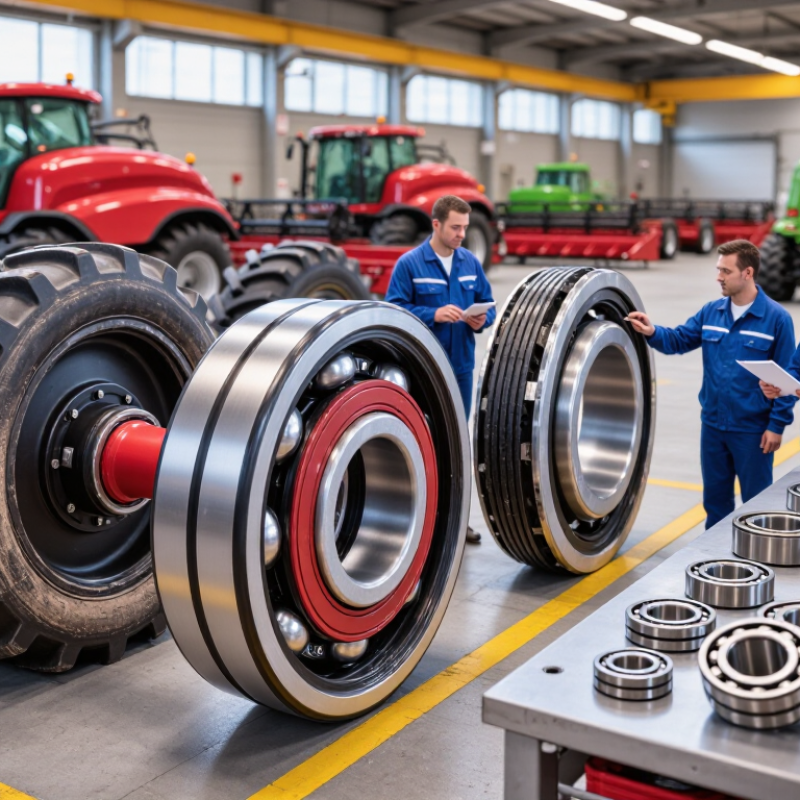
Agricultural bearings support rotating parts exposed to dust, moisture, vibration, and changing loads. Common types include deep-groove ball bearings for lighter, faster rotation and tapered or spherical roller bearings for heavier loads and misalignment. Sealed units are often used in wheels, disc harrows, and planting equipment, where dirt can quickly damage rolling surfaces. On a working farm, a bearing near a muddy wheel faces very different conditions from one inside a protected gearbox.
Operating requirements depend on the machine, speed, load, and environment. Check the equipment maker’s specifications for dimensions, load ratings, clearance, and sealing. Correct alignment and a sound shaft fit help prevent excess heat and vibration. Lubrication matters, too: too little grease can accelerate wear, while too much may increase heat. Field conditions are rarely tidy. A technically suitable bearing can still fail early if installation is rushed or contamination enters during servicing.
Tips: Keep spare bearings clean and dry, and inspect seals for cuts or hardening. After installation, run the machine briefly and check for unusual noise, heat, or play. A quick check helps, though it cannot replace scheduled maintenance.
Common options include deep-groove, spherical roller, and tapered bearings. A disc harrow needs different support from an irrigation pump. Check bore size, load rating, cage material, and sealing style.
Agricultural machines face dust, water, vibration, and uneven loads. A seed drill may need different protection from a clean indoor machine. Match the bearing to speed, shock loads, moisture, and service intervals.
Request drawings, material specifications, heat-treatment records, and inspection results. Ask for bore measurements, radial clearance, hardness, and seal-performance data. The records should match the exact bearing model.
Ask for documented inspection methods and material traceability. Batch-level test records are useful. A quality certificate shows process discipline, not guaranteed field performance.
Use ISO 281:2007 as a reference for dynamic load ratings and calculated life. The L10 rating represents 90% reliability under stated conditions. Real service life may change with dirt, lubrication, and installation errors.
Ask how grease quantity is controlled and measured. Request evidence showing resistance to fine soil and splash water. Seal quality matters greatly.
Compare heat treatment, grinding precision, seal design, and automated inspection. Better control may support quieter running and steadier dimensions. Still, product lines can vary within one supplier.
No. A visit can reveal clean assembly areas, calibrated gauges, and separated materials. It cannot prove long-term field life. Compare sample results with repeat orders, delivery records, and technical communication.
A trial installation can reveal poor fit, noise, or sealing problems. Test the bearing under normal field conditions, with real dust and vibration. I would not trust polished factory photos alone.
This article explores Agricultural Bearings and their role in supporting the demanding work of farm machinery. It outlines common bearing types, their uses in equipment such as tractors, harvesters, and planting machines, and the operating conditions they must withstand, including dust, moisture, vibration, heavy loads, and long working hours. It also introduces China’s agricultural bearing manufacturing landscape, describing how manufacturers serve a varied market with products for different machines and operating environments.
The article compares product ranges, quality practices, and manufacturing technologies, while emphasizing that specifications and performance can vary among suppliers. It then offers a practical framework for evaluating and selecting a Chinese agricultural bearing supplier. Buyers can consider application requirements, material and design options, quality-control processes, technical support, production capacity, delivery reliability, and communication. Matching these factors to the machinery’s conditions can help buyers make a well-informed choice and support dependable equipment operation.

 Jito Bearing